Typical challenges - and how we solve them
Functioning fire extinguishing systems are an essential part of fire protection. Deposits of rust, sludge or old foam concentrate constrict the pipes and interfere with the triggering. Mobilized particles can clog nozzles or damage pumps.
Particularly critical: residues from PFAS-containing foam. With Comprex® we thoroughly clean water and foam-based systems – for demonstrably safe systems.
The problem
Over the years, solids such as rust, sludge, biofilm or old foam compound residues build up in fire suppresion systems.
These residues constrict the cross-section, clog nozzles and impair the triggering function – in an emergency, the system fails.
Particularly critical: residues from PFAS-containing foams (e.g. AFFF) in foam-based fire suppression systems, which endanger people, the environment and insurance cover.
The solution
With the Comprex® process, we clean your fire suppression system gently and effectively – without time-consuming dismantling. Air-water pulses are used to loosen and remove deposits from the pipe system.
For PFAS-contaminated systems, we combine mechanical cleaning with a deep rinse based on the Fluorofighter™ additive.
Typical areas of application:
Sprinkler systems
Water spray systems
Water mist systems
Foam fire suppression systems
The result
After cleaning, the extinguishing medium flows freely again. Your system complies with all testing and insurance requirements – and, in PFAS applications, even meets laboratory standards.
On request, you will receive complete cleaning protocols and residue analyses. This safeguards your operation and optimally prepares your system for tests or a foam concentrate changeover.
Water or foam fire suppression system - what's the difference?
Water-based fire suppression systems
Sprinkler, water spray and water mist systems are permanently or temporarily filled with water (with additives if necessary).
Particularly in galvanized or uncoated steel pipes, standing liquid leads to rust formation, deposits and biological growth.
The result: reduced flow, malfunctions, clogged nozzles. Regular mechanical cleaning provides long-term protection against these risks.
Foam fire suppression systems
These systems are mainly used in industrial plants, storage areas, tank fields or special buildings. They work with a water-foam mixture or separate foam compound lines.
In many cases, foams containing PFAS (e.g. AFFF) were previously used. Their residues are considered particularly stubborn and toxic – they accumulate throughout the entire system and make it impossible to switch to modern fluorine-free foams (F3) without thorough cleaning. This is where our combined cleaning with Fluorofighter™ comes into play.
How Comprex® sustainably improves the functional reliability of your extinguishing systems
Comprex® reliably removes deposits, incrustations and stagnation residues from extinguishing water pipes – for clear cross-sections, safe water discharge in an emergency and permanently functional fire protection systems. Without any chemical additives.
- HYGIENIC CONDITIONS
- IMPROVED HYDRAULICS
- SUSTAINABLE GRID OPERATION
- INCREASED OPERATIONAL SAFETY
- INCREASED PERFORMANCE
- ENERGY-EFFICIENT OPERATION

Limescale deposits from a drinking water pipe in the distribution network

Iron sludge from a well water pipe

Manganese deposits from a drinking water network

Before and after cleaning: Semi-solid iron sludge in a raw water pipe

Iron incrustations from a drinking water pipe

Turbidity monitoring: water samples during Comprex® cleaning

Sludge discharge from a raw water pipe
Benefit from the Comprex® advantages now!
Whether drinking water and waste water in municipalities, industrial piping systems or water pipes in buildings – each area has its own requirements. We work with you to develop a tailor-made cleaning solution that works, saves resources and delivers lasting results.
Fast, thorough, resource-saving - without chemicals
Up to 80% shorter
Up to 100x stronger
Up to 90% less
Up to 10x faster
3 steps to a clean system
Step 1 Analysis & planning
We analyze your system: structure, plans, pipe routing, shut-off valves, nozzle technology. Together we plan cleaning sections, venting points and – if necessary – dismantling (e.g. of sprinkler heads).
For foam fire extinguishing systems, we also check concentrate lines, mixers, tanks and residual quantities in the system.
The result: a well thought-out process plan for safe and resource-saving cleaning.
Step 2 Cleaning
We flush the pipe system specifically and efficiently with suitable equipment.
- With water-based fire suppression systems, air-water pulse cleaning is usually sufficient – without chemicals, quickly and effectively.
Foam fire suppression systems with PFAS are additionally decontaminated in two stages:
Pre-cleaning: Removal of old foam concentrate, biofilm and foam residue
DeepClean: rinsing with heated Fluorofighter™ solvent + Comprex® for maximum depth effect
All residues are collected and, if necessary, filtered through activated carbon – environmentally friendly and tested.
Step 3 Completion & documentation
After cleaning, we check the results (e.g. visually or in the laboratory) and document them in writing.
In the case of PFAS, you will receive documentation with a laboratory analysis of the flushing medium. Our protocols serve as proof for insurers, authorities or experts.
Your fire suppression system is fully functional again – and ready for tests, conversions or the next emergency.
Fast, professional and ready for use: Our experienced team will take care of the cleaning for you – whether as a one-off or regularly as part of your maintenance concept.
Would you like to use the Comprex® process yourself? No problem. Our mobile systems are available for hire – including instruction, accessories and technical support.
Would you like to permanently integrate your own Comprex® cleaning system into your operating processes? Whether mobile or stationary – we have the right system for you and will train your staff.
"I wouldn't have believed it if I hadn't seen it myself at the Landau test center. In detailed trials cleaning our products in test pipelines, we reached up to 60% savings in cleaning time and up to 90% in water consumption."
"The MCU-300 from Hammann represents an important component of our innovative industrial hygiene concept. The system is used at Meffert AG both for flushing pipelines and for cleaning stand-alone systems.
The cooperation with the colleagues from Hammann has worked very well since the beginning of the project.
Project planning and commissioning were transparent and professional. All inquiries are processed promptly, and ideas and optimization requests are discussed openly with our technical department even months after commissioning.
The MCU300 is intuitive for our employees to operate, can be used almost anywhere due to its dimensions, and works very reliably."
"Before flushing the main pumping station, we had a pump runtime of almost 20 hours and a pumping capacity of 250 m³ of wastewater. As a result of the flushing action, we were able to determine that on some days we achieve a pumping capacity of 270 m³ of wastewater with a pump runtime of 15 hours. This clearly shows an improvement in the efficiency of our system.
"It is no longer possible to imagine our maintenance of injection molds without the cleaning technology from HAMMANN. The Comprex® cleaning is without alternative in very many applications. Thank you for the excellent and pragmatic service."
"The Hammann company was commissioned to clean the stainless steel gas pipe using their Comprex process. Success was already evident when the cleaning was carried out, as the escaping rinse water was heavily contaminated.
After cleaning and recommissioning, the aforementioned pressure fluctuations did not occur again. It was not easy to create the necessary inlet and outlet to the gas pipeline. It is also problematic to take a gas pipeline out of service for a longer period of time when there is no redundancy. Nevertheless, the effort was worth it, as the cleaning has had the desired effect."
"Our initial skepticism that comprex could be too intense for our piping system was unfounded. The pulse pressure always remains below the network pressure and so we don't have to worry about pipe bursts due to excessive pressure. The pulse flushing process can reduce the deposits in our old network so significantly that maintenance is absolutely economically viable compared to replacement."
"Our conclusion: The test of the Comprex® unit can be rated as thoroughly positive. The cleaning effect can be seen as very good, in some cases even blockages could be loosened. Due to the rather simple operation, the unit could be operated without any problems after the short instruction. No problems were encountered during the test phase.
At this point, we would like to thank you again for the test opportunity and the trust you have placed in us."
"We have had very good experiences with comprex and are very satisfied with the cooperation that has grown over the years. The Hammann GmbH technicians know our network, arrangements are quick and uncomplicated and the assignments are already a fixed part of our annual planning for network maintenance."
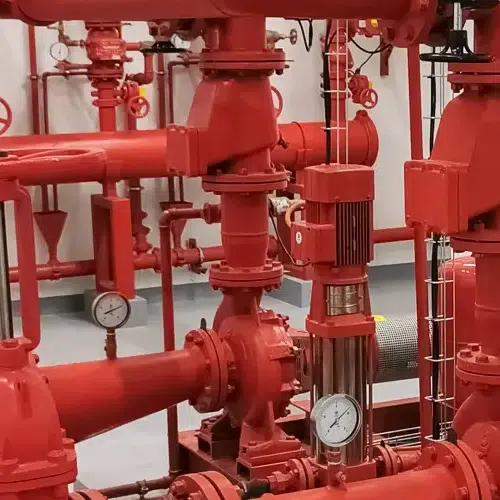
Remove PFAS from extinguishing systems
Extinguishing water pipeline logistics and transport company
Discover more applications
Frequently asked questions about cleaning fire suppression systems
How does cleaning with Comprex® work?
The patented process works with specifically controlled air-water impulses. These move through the pipes at high speeds (up to 70 km/h) and generate strong shear and drag forces. This efficiently dissolves and removes deposits and residues – completely without chemicals and with minimal use of water.
Are the procedures certified?
For water-based fire extinguishing systems, cleaning is carried out on the basis of VdS/TÜV experience. For PFAS cleaning, the Fluorofighter™ additive is used in compliance with REACH and POP regulations and in accordance with official requirements. We can provide WHG certifications or SCC certificates if required.
Is cleaning with Comprex® suitable for all types of fire extinguishing systems?
Yes, Comprex® is suitable for dry and wet pipes, ring pipes, risers and system components such as wall hydrants, sprinkler or SHEV systems. Even branched networks or pipes with dead sections can be cleaned in a targeted and effective manner – without dismantling.
Can the cleaning take place during operation?
We coordinate the planning with you individually so that the cleaning process involves minimal disruption to building operations. We always keep safety requirements and applicable regulations in mind. If necessary, we will develop an emergency extinguishing concept with you.
How long does the cleaning take?
The duration depends on the size of the pipe system and the degree of soiling or contamination. We will be happy to draw up a schedule in advance based on your system structure.
How is the cleaning effect verified?
After cleaning, we check the results (e.g. visually or in the laboratory) and document them in writing.
An inspection (e.g. 25-year inspection) is carried out subsequently by accredited testing institutes.
In the case of PFAS, you will receive a laboratory analysis of the flushing medium. Our reports serve as proof for insurers, authorities or experts.
Can I use fluorine-free foams immediately after cleaning?
After documented PFAS removal (laboratory report), the system is considered “clean” and is ready for the changeover.
What exactly are "fire suppression systems"?
The term fire suppression system is also used to describe a fire-fighting or fire-extinguishing system. It refers to a permanently operational technical installation designed to control or suppress a fire using an extinguishing agent.
Stationary or fixed fire suppression systems typically consist of a piping network with appropriate discharge devices, such as sprinkler heads or nozzles, which release the extinguishing agent when required. In the event of a fire, activation occurs either indirectly via fire detection systems or directly through release elements such as glass bulbs or fusible links.
These systems are designed to automatically keep a fire under control until the fire brigade arrives to extinguish it. The colloquial term “extinguishing system” is therefore somewhat misleading, which is why technical literature generally uses the terms fire-fighting system or fire-suppression system.
What is the purpose of fire suppression agents?
Extinguishing agents serve to suppress flammable substances, taking into account their fire class and the prevailing environmental conditions (e.g. risk to persons or room size).
In water-based extinguishing systems, water alone, water with additives, or extinguishing foam is mainly used. Extinguishing foam is produced by adding air to water mixed with a foaming agent.


