

Together with Arcadis and Kenbri Fire Fighting, Comprex® enables complete cleaning and decontamination of PFAS-containing foam fire suppression systems.
This is how the switch to fluorine-free foams (F3) succeeds – legally compliant, documented and sustainable.
Why PFAS removal can’t wait
PFAS (“per- and polyfluorinated alkyl compounds”) are among the so-called forever chemicals. They are contained in older AFFF foam concentrates and can cause long-term harm to humans and the environment. The EU is planning a far-reaching ban on these substances, and foam concentrates containing PFAS may soon no longer be permitted in many applications.
This means for operators of fire suppression systems:
Old AFFF foam concentrate must be properly disposed of.
Systems must be thoroughly cleaned and decontaminated before fluorine-free foam concentrates (F3) can be used.
Documentation of cleaning is mandatory for authorities and insurers.
We support you every step of the way – from analysis to cleaning to the certified conversion of your fire suppression system.
Strong partnership for reliable results
Three specialists work hand in hand on PFAS decontamination:
- Comprex® ensures the mechanical deep cleaning of the pipe network with air-water impulses.
- Arcadis supplies Fluorofighter®, the chemical component that reliably dissolves PFAS residues.
- Kenbri Fire Fighting contributes its expertise in foam concentrate technology, mixers and recommissioning.
Three specialists work hand in hand on PFAS decontamination:



Comprex® ensures the mechanical deep cleaning of the pipe network with air-water impulses.
Arcadis supplies Fluorofighter®, the chemical component that reliably dissolves PFAS residues.
Kenbri Fire Fighting contributes its expertise in foam concentrate technology, mixers and recommissioning.
Strong partnership for reliable results
Three specialists work hand in hand on PFAS decontamination:
- Comprex® ensures the mechanical deep cleaning of the pipe network with air-water impulses.
- Arcadis supplies Fluorofighter®, the chemical component that reliably dissolves PFAS residues.
- Kenbri Fire Fighting contributes its expertise in foam concentrate technology, mixers and recommissioning.
Three specialists work hand in hand on PFAS decontamination:

Comprex® ensures the mechanical deep cleaning of the pipe network with air-water impulses.
Arcadis supplies Fluorofighter®, the chemical component that reliably dissolves PFAS residues.
Kenbri Fire Fighting contributes its expertise in foam concentrate technology, mixers and recommissioning.
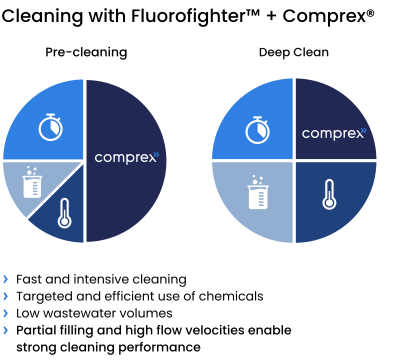
Together we implement a two-stage cleaning process:
Pre-cleaning with Comprex®
The system is completely flushed, old foam concentrate residues and loose deposits are removed.
Deep Clean with Comprex® + Fluorofighter®
The system is flushed at elevated temperature with chemical support to completely remove even persistent PFAS residues.
The result is a fully coordinated process that removes all residues from the system – documented, tested and ready for the use of fluorine-free foams.
Strong partnership for reliable results
Three specialists work hand in hand on PFAS decontamination:
- Comprex® ensures the mechanical deep cleaning of the pipe network with air-water impulses.
- Arcadis supplies Fluorofighter®, the chemical component that reliably dissolves PFAS residues.
- Kenbri Fire Fighting contributes its expertise in foam concentrate technology, mixers and recommissioning.
Together we implement a two-stage cleaning process:
Scientifically sound, proven in practice
Our cleaning principle is based on the Sinner’s circle – the interplay of mechanics, chemistry, temperature and time.
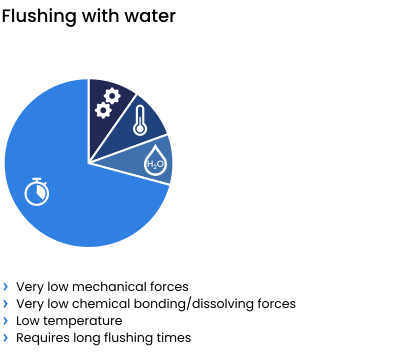
While conventional water flushes only rely on time and flow, our method makes targeted use of all four effective factors: Mechanics through the Comprex® impulses, chemistry through Fluorofighter®, increased temperature for intensification – and optimized flushing time for maximum effect.
The result: fast, deep cleaning with minimal water consumption, ideal for PFAS-contaminated foam fire suppression systems.
Advantages at a glance
Comprex® dissolves deposits and PFAS films using impulse energy, while Fluorofighter® breaks the chemical bond of the residues.
Partially filled pipes and pulsating flow ensure intensive flushing without long downtimes.
All flushing media are collected, filtered and disposed of properly.
After cleaning, the result is confirmed by laboratory analysis. The risk of a rebound is also significantly reduced by removing the contaminated sites in the PreClean phase.
Every cleaning is monitored, logged and documented in a traceable manner.
Certificates & proofs
We and our partners work to the highest quality and safety standards. All processes used are tested and certified.
| ZIM Cooperation Project MoNNitor | Learn more |
| KMU-innovativ joint project REINER | Learn more |
| ZIM Cooperation Project HEATERS | Learn more |
| BMBF joint project "Microbial Ochreization" (Anti-Ochre) | Learn more |
| RWE research project "Flushing and cleaning concept for transport pipelines". | |
| BMBF joint project "Biofilm Management | Learn more |
| EU project "SecurEau | Learn more |
| DVGW-TZW Research Project "Disinfection in Drinking Water Installations | |
| BMBF joint project "Biofilms in domestic installations | Learn more |
| IKT research project "Wastewater pressure lines | Learn more |
We and our partners work to the highest quality and safety standards. All processes used are tested and certified.
| comprex: WHG specialist company |
| comprex: SCCP certification |
| comprex: VdS-certified |
| ??? Arcadis laboratory analyzed |
| ??? Arcadis / Fluorofighter®: REACH-registered |
| ??? Kenbri: ISO 9001-compliant |
Ready to switch to fluorine-free foam concentrate?
We support you from analysis to commissioning – with experience, certified processes and strong partners.
FAQs about PFAS in Firefighting Systems
What are PFAS and why are they considered hazardous?
PFAS (per- and polyfluoroalkyl substances) are technically extremely stable chemicals (“forever chemicals”) that were previously used deliberately in firefighting foams. They can enter the human body through skin contact, inhaled aerosols or contaminated water and are eliminated only very slowly. Scientific studies associate PFAS, among other things, with impairments of the immune system, liver function and hormonal changes. Due to these health risks, PFAS are now classified as particularly problematic and are labelled accordingly.
Which regulatory obligations apply to operators of fixed firefighting systems?
With EU Regulation 2025/1988, the use of PFAS-containing firefighting foams is being phased out. By 31 December 2030 at the latest, PFAS-containing extinguishing agents may no longer be used in fixed firefighting systems. Independently of this, certain PFAS are already subject to strict limit values and substance bans under EU law. Operators are required to identify PFAS-containing firefighting foams, assess their composition and – depending on the substance, quantity and concentration – fulfil further obligations such as replacement, disposal or notification.
Why is replacing the extinguishing agent without cleaning the system insufficient?
PFAS bind to internal surfaces of pipework, valves, pumps and storage tanks. Simply replacing the extinguishing agent does not remove these residues. In practice, PFAS remain detectable within the system after a media change and may be released again during pressure changes, maintenance work or a firefighting event. Without targeted cleaning, the system remains technically contaminated – even if a PFAS-free extinguishing agent is already in use.
For which systems is targeted PFAS cleaning required?
Professional PFAS cleaning is particularly required for large-volume fixed foam firefighting systems with long or branched pipe networks – for example in refineries, chemical plants, tank farms, airports or large logistics centres. The more complex the system and the greater the volume of extinguishing agent it contains, the higher the risk that PFAS residues will remain within the system and later be released in an uncontrolled manner.
The Comprex® impulse flushing process is specifically designed to reliably clean complex, branched pipe systems with varying nominal diameters, valves, dead zones and risers – even under existing system pressure.
Which PFAS are currently regulated – and why is this relevant for operators?
Firefighting foams may contain different PFAS, each subject to specific statutory limit values. PFOS, PFOA, PFHxS and certain long-chain perfluorinated carboxylic acids are already regulated. Permissible limit values are sometimes set at very low concentration levels and are being further tightened. For operators, this means: even low PFAS concentrations may result in a firefighting foam being considered non-compliant – with corresponding need for action.
Is there a notification obligation for PFAS-containing firefighting foams?
Yes. Under EU law, a notification to the competent authority is required when certain conditions are met – in particular where relevant quantities of firefighting foam are present and defined limit values for individual PFAS or PFAS groups are exceeded. This notification obligation may also apply to firefighting foams used in fixed firefighting systems. Operators should therefore assess at an early stage whether their system is subject to notification requirements.
How are insurers responding to PFAS-contaminated firefighting systems?
Many insurers now assess PFAS as an independent environmental risk and exclude related damage wholly or partially from insurance cover. For operators, this means: PFAS-related environmental damage may fall entirely under their own liability. The documented replacement of PFAS-containing extinguishing agents and the reduction of PFAS residues within the system are therefore becoming increasingly important for the insurability of industrial facilities.